Beginner's Guide to Off-Grid Power for a Small Woodland Cabin
There is a particular kind of quiet that comes from a cabin with no meter on the wall. No standing charge, no trench to dig to the nearest pole, no wondering what happens when the power fails, because there was never any to lose. The trade-off is that you become the power station. You decide what gets used, when, and how much you are prepared to carry in on your back. This is about making that job manageable in a British wood, where the sun is more of a suggestion than a guarantee.
Start with an energy budget, not a shopping list
Almost everyone buys panels first and works out what they want to run second. Do it the other way round. Write down every device you genuinely need, how many watts it draws, and how many hours a day it runs. Multiply watts by hours and you have watt-hours, the only number that really matters.
A few honest examples:
- Four 3W LED lights, four hours a night: about 48Wh
- Charging two phones: roughly 20Wh
- A 12V shower pump, fifteen minutes: around 15Wh
- A laptop, three hours: 150Wh and upwards
- A 12V compressor fridge: it will dominate your entire system, and deserves serious thought before you commit
Heating and cooking do not belong on this list. Keep them on wood, gas or liquid fuel, and your electrical system stays small, cheap and simple. A modest cabin can run happily on a few hundred watt-hours a day. Add one fridge or an electric kettle and you have tripled the project.
Solar in a wood: light is the scarce resource
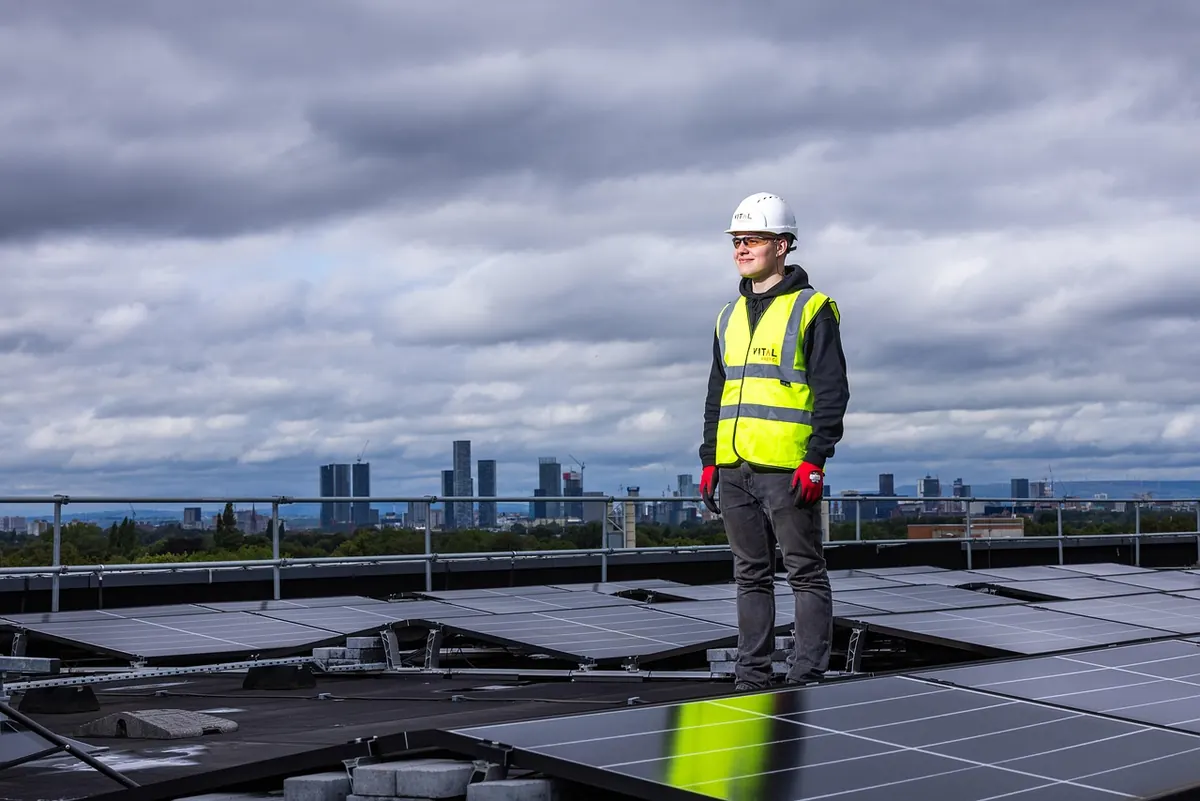
Woodland is shade. A panel tucked under a canopy in July will underperform all year, and in a grey December a 100W panel that sparkles in June may deliver only a trickle of what the label promises. Plan for that: oversize the array, and mount it where it catches the middle of the day, ideally facing south at a steeper tilt in winter to meet the low sun.
Practical woodland points:
- Check for shading across the whole day, not just at noon. Even a branch across one corner can flatten output, particularly on panels wired in series.
- Clean panels of sap, pollen and leaf litter. A soft cloth and rainwater do more for output than any gadget.
- A portable or folding panel you can carry to a clearing beats a fixed one in permanent gloom.
- Choose an MPPT charge controller rather than a basic PWM type. It extracts noticeably more in weak, diffused light, which is most of the British winter.
If the site is truly dark from October to March, accept it. Charge a large power bank from the mains before you travel, run a small generator occasionally, or plan your stays around the lighter months.
Batteries: the part that decides how you live
Lead-acid leisure batteries are affordable and forgiving of a rough-and-ready setup, but you should only use about half their rated capacity regularly, they are heavy to carry in, and they give off hydrogen while charging, so they need ventilation. Lithium (LiFePO4) units let you use far more of their capacity and last longer, but they cost more and most will not accept a charge below freezing, which matters in an unheated cabin. A low-temperature cut-off is worth having.
Whatever you choose, keep the bank inside the insulated part of the cabin if you can, and accept that cold reduces usable capacity. Fuse every positive cable close to the battery, size cables generously for the current and the run length, and keep the controller close to the battery. Low-voltage systems lose a surprising amount of power over long thin cables. If electrical work is not something you are confident about, have a qualified electrician check the installation; a shorted battery can start a fire.
Lighting: the easiest saving you will make
Skip anything incandescent or halogen. A handful of 12V LED lights at two to four watts each will light a cabin beautifully, and warm white versions in the region of 2700 to 3000K feel far more welcoming than cold blue light in a timber room.
Use lamps where you need them rather than flooding the whole space: a light over the sink, one over the table, one by the bed. Add head torches and a couple of rechargeable lanterns for evenings outdoors. An outdoor security light on a tiny separate panel and battery saves your main bank for indoor use.
Heating without wrecking the batteries
Electric heating is out of reach at cabin scale. A one-kilowatt heater pulls more energy in an hour than a small battery bank comfortably holds, and you would be recharging for days. The realistic options are a small wood-burning stove with seasoned, dry wood, a diesel or kerosene heater with its own fuel tank, or a bottled gas heater used with proper ventilation.
Insulation is the cheapest heat you will ever buy: loft roll, floor boards, draught strips around the door, heavy curtains and a lined chimney. A well-sealed cabin at 12°C feels far better than a leaky one at 18°C. Fit a carbon monoxide alarm, keep a vent open, and never run a fuel-burning heater in a sealed space overnight without understanding the risks.
A sensible first system
- Work out your daily watt-hours, then add half again for grey days.
- Buy the largest unshaded panel, or pair of panels, you can manage.
- Fit an MPPT controller rated comfortably above your array.
- Choose a battery sized for two or three days of use without sun.
- Fuse everything, keep cable runs short, and test in autumn rather than midwinter.
Living with a finite supply
Off-grid power is mostly a set of habits. Charge devices in the middle of the day when the panels are working. Run one light at a time. Choose 12V devices where you can, and keep an inverter for occasional use only, as it wastes power even when idle. Log your consumption for a week; the pattern will tell you more than any specification sheet.
The best rule is to add generation before you add a load. A spare panel or an extra battery gives you slack, and slack is what makes a cabin feel like a home rather than a science experiment.